2025 was a year of intense economic debate in South Africa. From the shift to a lower inflation target to stabilising public debt and discussions around the size of the informal economy, we’ve been there to crunch the numbers.
At Codera, we believe that better data leads to better decisions. This year, we published dozens of deep dives, dashboards, and policy papers. If you missed any, here is our Codera Wrapped—a summary of our best and most impactful posts of the year.
1. The Great Inflation Debate
Inflation remained the central macroeconomic theme of 2025. Our work focused heavily on the mechanics of price pressures and the policy debate around lowering the inflation target.
- The Target: The biggest policy discussion of the year was undoubtedly the potential shift to a lower target. We explored recalibrating SA’s inflation target, published a policy paper on the implications of a lower inflation target, and argued that a “Team SA” approach is needed for a low-cost transition, including a social compact, otherwise the private sector will bear the burden of lowering inflation.
- The Drivers: We dug into the details, analyzing inflation dynamics by category, showing how administered prices diverge from headline and core inflation and developed a new measure of inflation pressure.
- Expectations: Crucially, we asked whether inflation expectations are falling fast enough and analyzed how expectations adjusted to previous target changes.
- Market impacts: Our nowcast report (see snippet here) provides accurate real-time insights at a granular detail. We also presented modelling results of FX pass-through to inflation and how the currency and yield curve react to inflation surprises.
More on Inflation and the target:
- Upgraded CPI Common suggests higher underlying pressures
- Comparison of sacrifice ratio estimates for SA (and Codera’s estimates)
- Is SA in a low inflation regime?
- Assessing the stance of monetary policy
2. Understanding SA’s investment decline
In 2025, Codera Analytics highlighted the dramatic decline in the national investment rate towards pre-democracy lows. Critical issues we highlighted:
- Declining Investment: We documented the decline in government investment and low private investment in intangible assets, resulting in a decline in the capital stock in most industries and falling potential growth.
- Low returns and policy constraints: In our widely read piece, Understanding South Africa’s investment freeze, we showed how investment returns have declined and how government policy has become steadily more anti-growth, and policy uncertainty and SA’s geopolitical gamble undermined confidence.
- Negative Investment Multipliers: Our estimates suggest that neither private nor public investment has effectively stimulated faster economic growth in recent years, contributing to South Africa’s productivity slowdown.
More on Investment:
- SA’s rising compliance burden in two charts (here and here)
- Why commodity windfalls don’t trickle down in SA
- Why are SA firms not innovating? A deep-dive into mining
- Are SA businesses shrinking? Why?
3. Fiscal Reality Checks
Our analysis of the public purse highlighted significant structural constraints.
- Fiscal Analysis: EconData’s public finance module makes it easy to automate fiscal analysis and scenarios, which our public finance chartpack and fiscal slippage analysis summarise.
- Surprising spending: We tracked the pennies and the planes, going deep on budget surprises and spending on big ticket items like infrastructure, grants, subsidies, and even asking how much does SA’s president travel? (Spoiler: A lot—24 flights in just 90 days).
- Debt Dynamics: We analyzed public debt ownership and issuances, estimated credit premia, assessed the fiscal stance and asked the trillion-Rand question: When will public debt stabilise?
More on Fiscal Policy:
- What was emphasized in Budget 3.0?
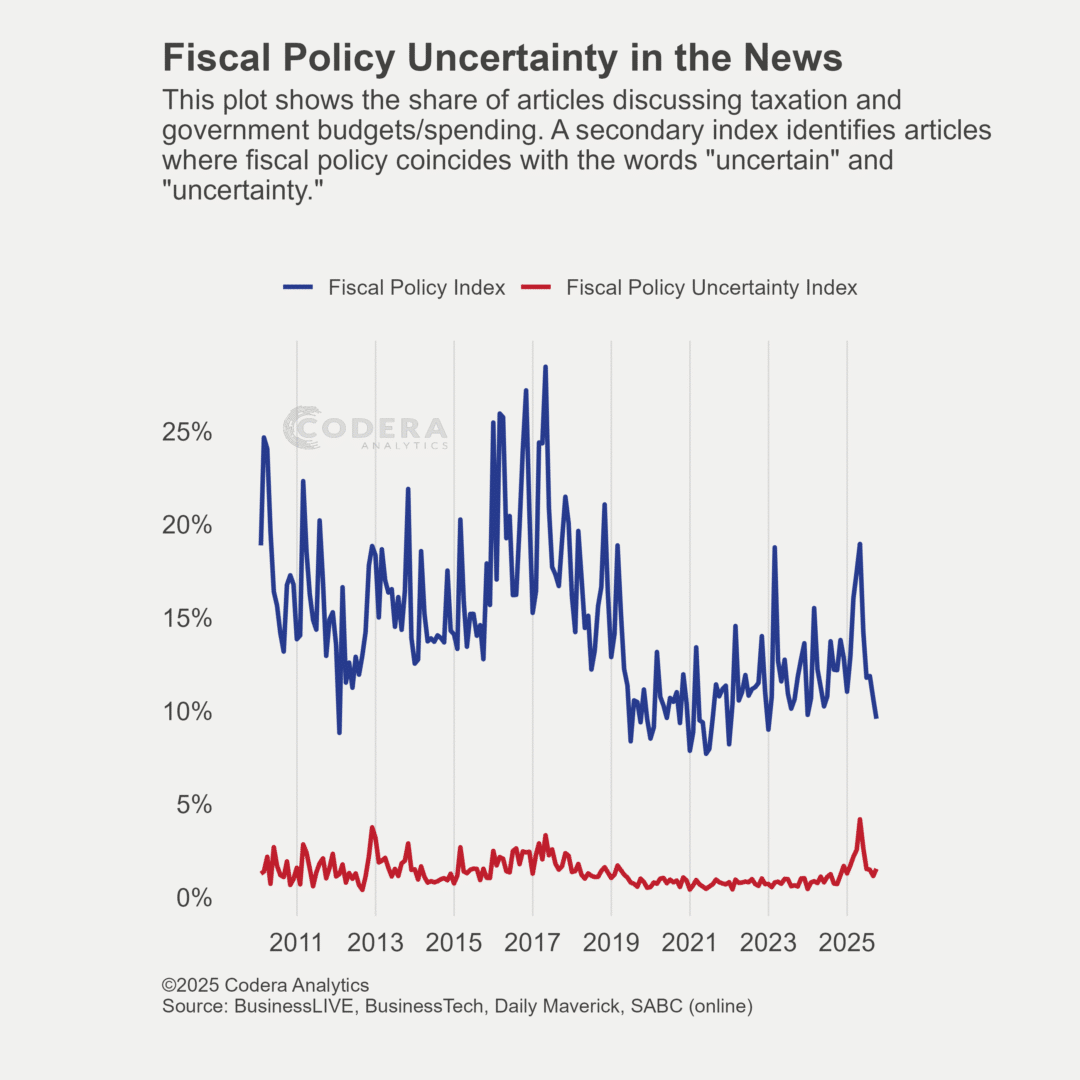
- Measuring fiscal uncertainty
- Pushing back on the idea that money printing creates jobs
- Taxpayers numbers in South Africa
4. Housing, Banking & Assets
From the property boom in the Cape to the intricacies of the banking sector, we looked at where South Africans are putting their money.
- Real Estate: One of our most popular posts showed that Cape Town house prices are up 25% in real terms since 2010, decoupling from much of the rest of the country. We also offered advice on what AirBnB owners should do to boost rents and tracked Western Cape residential rental inflation.
- Banking: We launched our Banking Dashboard for SA, assessed banking profitability and how net interest margins change, and analyzed what banks are concerned about in their public communication.
- Funds Management: Our ASISA module enables fund-level deep dives, and we presented summaries of the largest collective investment schemes, composition of unit trust holdings and foreign funds
- Automotive: Using web-scraped data, we compared second-hand car prices and mileage on Cars.co.za and WeBuyCars.
- Construction: We documented the continued decline in construction per capita

More on Markets:
- JSE Bull and Bear Markets
- Selected yield curves over time
- FX sensitivity to interest rate differentials
- Have market expectations of the outlook for the rand changed?
- South African Stocks Remember… to Fall in September
5. Labour, Wages & Inequality
The real economy is about people. Our labour market analysis this year focused on the gap between the formal and informal sectors and the stagnation of real wages.
- Wages: We mapped real average wages by industry and real gross earnings by age and sector.
- Employment Structure: We examined employment by industry and gender since 1993 and tackled the complex issue of employment equity regulations and workforce structure.
- The Informal Economy: We dedicated significant time to the measurement of the informal economy and informal sector occupations.
More on the labour market:
6. Data Engineering & Tools
Finally, we continued to refine the tools that make this analysis possible. This year saw major updates to our forecasting capabilities and data pipelines.
- Forecasting: We published our policy paper on forecasting economic downturns using machine learning and tracked the accuracy of Codera’s Nowcasts.
- Automation: We discussed automating analytics in economics and finance and a range of issues related to official statistics, including data revisions, availability and delays in official statistics.
- EconData: We’ve added a host of new datasets to EconData:
- World Bank module
- National Credit Regulator datasets
- Quarterly Employment Survey (QES)
- Spatial Tax Panel (STP)
- FX Forecasts
- Inflation Forecasts
- Fuel Prices
- World Economic Outlook
- SARS Customs: International Trade
- StatsSA Annual Financial Statistics (forthcoming)
- And updated existing datasets, including new CPI weights, provincial GDP, government budget data, fiscal year GDP data, and the full Quarterly Bulletin vintage history.
Thank you for reading, sharing, and debating our work in 2025.
If you want to stay ahead of the curve in 2026, make sure you are signed up for our newsletter and keep an eye on our Analytics Lab.
Compiled by Aidan Horn