
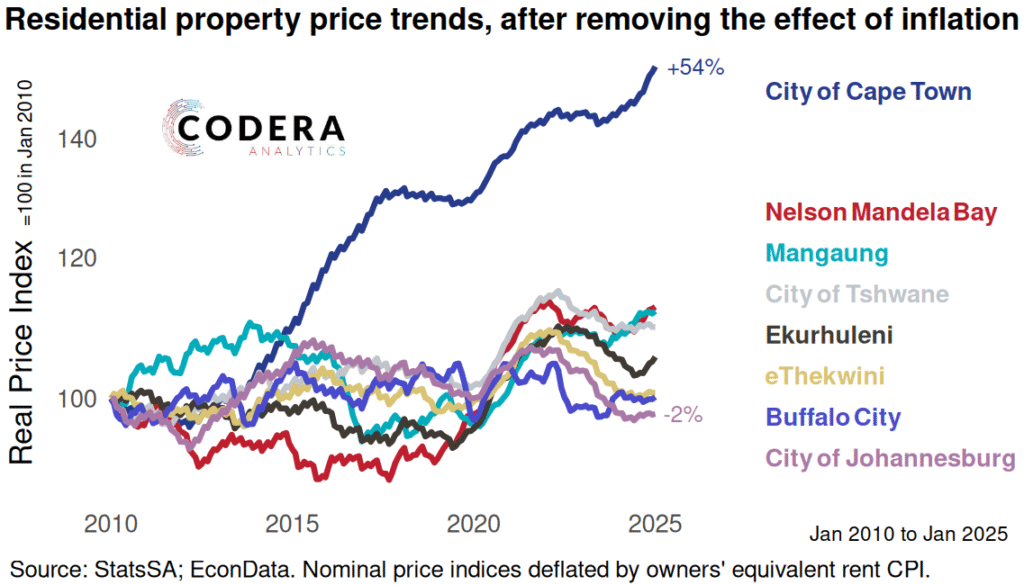
Residential property prices in SA compared to owners’ equivalent rent
This post by Aidan Horn compares residential house price developments across metros in South Africa compared to consumer inflation and owners’ equivalent rents. Cape Town is the only metro that has experienced meaningful real increases in property prices since 2010.
SA’s ‘narrower’ unemployment rate is 23%
This post by Aidan Horn shows that, while the official unemployment rate is currently 32.9%, it would be 23.5% if one considers subsistence farmers and scholars and homemakers as employed, and when the entire population (i.e. not restricting to the working-age population) is used in the calculation based on official data.

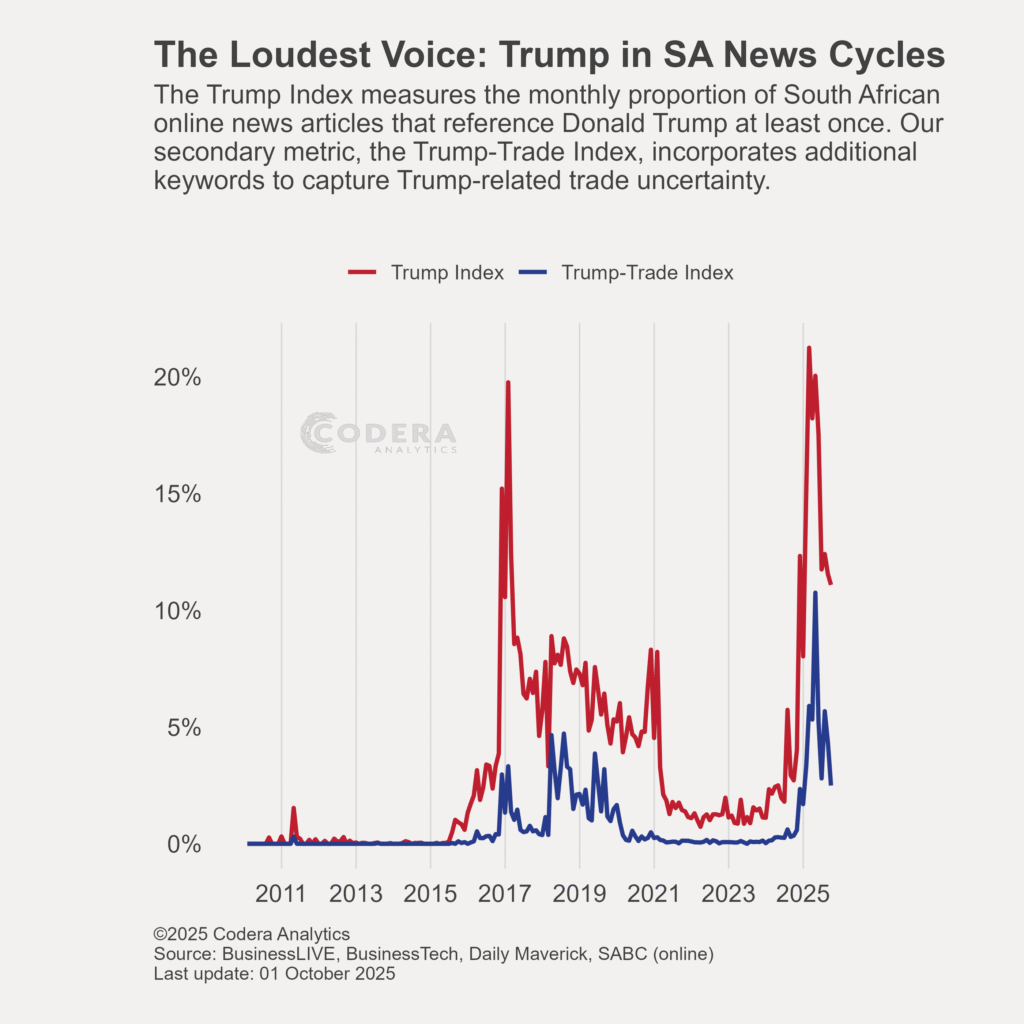
Codera’s Trump Index
In this post, Jacques Quass de Vos constructs a ‘Trump Index’ and ‘Trump-Trade Index’ to measure the frequency of mentions of US President Trump and the combination of ‘Trump’ and ‘Trade’ in the same South African and global news stories.
Population Pyramid for South Africa
Today’s post by Jan-Hendrik Pretorius shows that South Africa’s male–female population pyramid once had a wide base, reflecting a young population with high birth rates. Over time, it has become more column-shaped as birth rates have fallen and life expectancy has increased.

Inflation by affluence in SA
This post by Aidan Horn shows that the poor (decile 1) have typically experienced higher inflation than the wealthiest group in South Africa (decile 10). The poor also experience much more inflation volatility – almost 5 times more than the rich. This is because food is the major contributor to the inflation experienced by South Africa’s poorest, while rich people consume a more diverse set of goods and services, with housing and utilities
playing a larger role in driving their inflation outcomes, on average.

Most mentioned words in the media in SA
This post by Jacques Quass De Vos summarises the most commonly used words in SA media.

Mileage price distributions of second hand car platforms in SA
This post by Johan Hanekom compares the mileage and price distributions for various car body types across WeBuyCars.co.za and Cars.co.za.

What should AirBnB owners do to boost rents?
This post by Johan Hanekom shows that it is a Braai..

How large is CPI measurement bias in South Africa?
To estimate possible bias in the measurement of CPI, Lisa Martin calculated headline inflation from underlying 8-digit categories using the 2016 CPI weights and 2023 CPI weights. Codera estimates that CPI has been lower by an average of 0.5 percentage points since 2009 if measured using the most recent CPI weights.

South African legislation over time
This chart of the day by Johan Hanekom shows that the number of acts of legislation in South Africa has steadily increased over time.

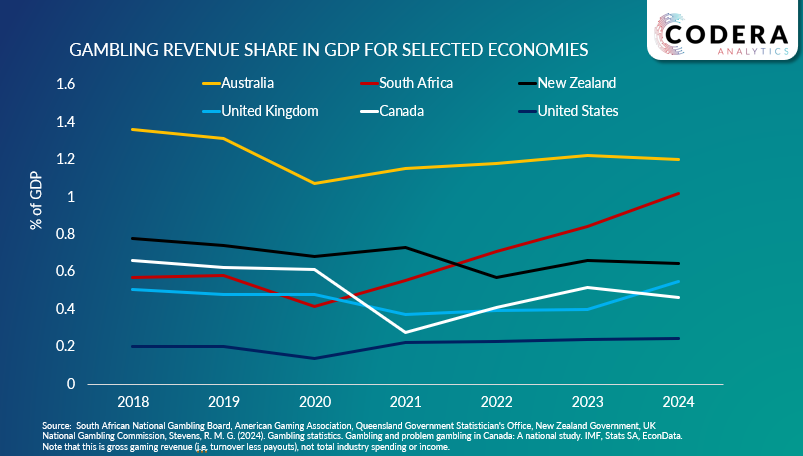
Gambling to GDP in selected economies
Gambling revenues account for over 1% of GDP in Australia and South Africa, meaningfully higher as a share of GDP than in New Zealand, Canada, the United Kingdom and the United States. Note that this is gross gaming revenue (i.e. turnover less payouts), not total industry spending or income.
Market and news-based monetary policy uncertainty in SA
This post with Jacques Quass De Vos compares two other market- and news-based monetary policy uncertainty measures for South Africa from Codera.

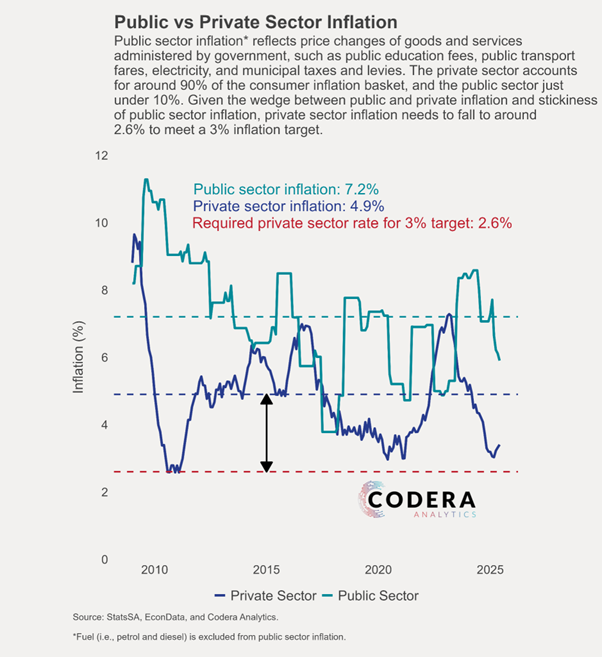
Required private sector inflation under 3% target in SA
This post by Oliver Guest shows that public sector inflation has averaged 7.2% since 2009, compared to 4.9% for private sector inflation (excluding fuel inflation). Given the wedge between public and private inflation and our expectation that government inflation will remain elevated, private sector inflation would need to fall to around half of its average level since 2009 (just under 2.6%).
Which universities patent the most in SA?
This post by Jan-Hendrik Pretorius shows that Stellenbosch University has been responsible for the most patent applications and grants among South African universities since 1918.

FX Hedge Ratios
This post by Oliver Guest estimates FX hedge ratios for selected major currencies. The hedge ratio describes the sensitivity of forward exchange rate changes to movements in the spot rate and is an important input into the optimisation of hedging strategies.

Value for money for wines from around the world
This post by Johan Hanekom and Jason Vermaak uncorks a global comparison of value for money of wines listed on Vivino. Per US dollar spent, South African wines offer relatively high value for money. However, Lebanon and Croatia offer higher average wine ratings when wine prices are expressed in common currency.

Top African Export Destinations
This post by Jacques Quass De Vos shows the top export destinations of African countries.

Inflation pressure picking up in SA
Codera’s measure of inflation dispersion compiled by Oliver Guest and Cynan Cleaver draws on hundreds of goods and services categories to summarise inflation pressure. As we showed in our recent policy brief, our inflation pressure measure describes divergences in inflation from the inflation target, with inflation tending to rise when the inflation distribution widens.

Exchange rate pass-through in South Africa
In this Policy Brief with Gabriella Neilon, we estimate exchange rate pass-through in South Africa using a non-linear cointegration approach. We find that it is important to control for pass-through asymmetry and that exchange rate depreciation tend to have a slightly stronger effect on inflation than appreciations for headline inflation.

Forecasting economic downturns in South Africa using leading indicators and machine learning
In this Policy Paper, Jurgens Fourie and Daan Steenkamp show that commonly used confidence indicators are only weakly contemporaneously correlated with business cycle phases in South Africa, and not highly correlated with GDP growth outcomes.

The market impact of inflation surprises in South Africa
Are inflation surprises perceived to be indicative of shifts in trend inflation? Is the yield curve a useful barometer of how the market interprets inflation data? How do inflation surprises affect asset prices? This Codera Policy Brief with Oliver Guest and Gabriella Neilon evaluates these questions by looking at historical market reactions to inflation surprises in South Africa.

Cash decline in SA and implications for SARB’s seigniorage
Historically, issuance costs have consumed around a quarter of implied seigniorage revenues in South Africa. As we have show, cash has stopped producing meaningful seigniorage for SARB since 2023, as a result of a decline in the stock of notes and coins and an increase in the cost of issuing and managing cash.

What are banks concerned about in their public communication?
Johan Hanekom scraped South African bank annual reports, and show there has been a big increase in mentions of Environmental, Social and Governance (ESG) issues over time. For the 2023 financial year set of results, the latest complete set available, mentions of the words ‘data’ and ‘AI’ increased strongly.

Explaining fiscal slippage in SA
Today’s post by Lisa Martin compares historical revenue and expenditure under/overshoots, showing that one of main reasons for the sustained ratcheting up of public debt has been lower-than-expected tax revenues and higher-than-expected government expenditure, particularly for compensation of employees, debt service costs, higher education and health care.

Inflation rates and weights for SA CPI
This post by Jan-Hendrik Pretorius shows that most high CPI weight categories currently have low inflation, with the exception of insurance and electricity.

Fiscal policy uncertainty in the news
This post by Jacques Quass De Vos measures the extent of fiscal policy uncertainty based on news reports in South Africa. The post demonstrates the sensitivity of measures based on word counts by comparing narrow and broader measures, where the latter includes more terms.

Codera’s term premium estimates
Today’s post provides an update of Codera’s term premium estimates for the South African sovereign bond curve. Focusing on the 10 year point, our estimates show that that the decline in long yields has reflected a fall in the term premium and not a reduction in average expected short rates. The implication is that market-implied neutral rate has not declined meaningfully since formal adoption of a lower inflation target.

Inflation attention and expectations
This post by Jacques Quass De Vos shows that inflation-related news coverage correlates with inflation expectations, suggesting that high levels of news coverage of inflation may contribute to stronger propagation of inflation shocks to wage demands and price setting behaviour.

Have market expectations of the outlook for the rand changed?
In today’s post, we back out market expectations of future USDZAR movements using options prices. The distribution of the USDZAR’s options-implied density has become more peaked, with more of the distribution’s probability mass at lower exchange rate levels as uncertainty around the mean expected value of USDZAR has decreased, particularly over a shorter horizon.

Suez Canal vs Cape of Good Hope Maritime Routes
This post by Jacques Quass de Vos shows that shipping traffic via the Suez Canal continues to be interrupted, with trade diverted via the Cape of Good Hope.

Low wage occupation employment in SA
This post by Aidan Horn shows that there has been significant increases in some low wage occupations such as garbage collectors and farmhands since 2000 in South Africa. The number of domestic workers, on the other hand, has declined.

What topics are dominating the news?
In this post, Jacques Quass de Vos measures the frequency of different political topics in South African and international news articles. The post shows that while loadshedding has been getting much less coverage, black economic empowerment (BEE) and land reform are back in the news.


