Today’s blog post is an ungated version of a Business Day article in which we discuss the difference between market expectations, economist predictions and SARB forecasts.
Is the Reserve Bank about to repeat its 2022 inflation mistake?
Daan Steenkamp and Oliver Guest
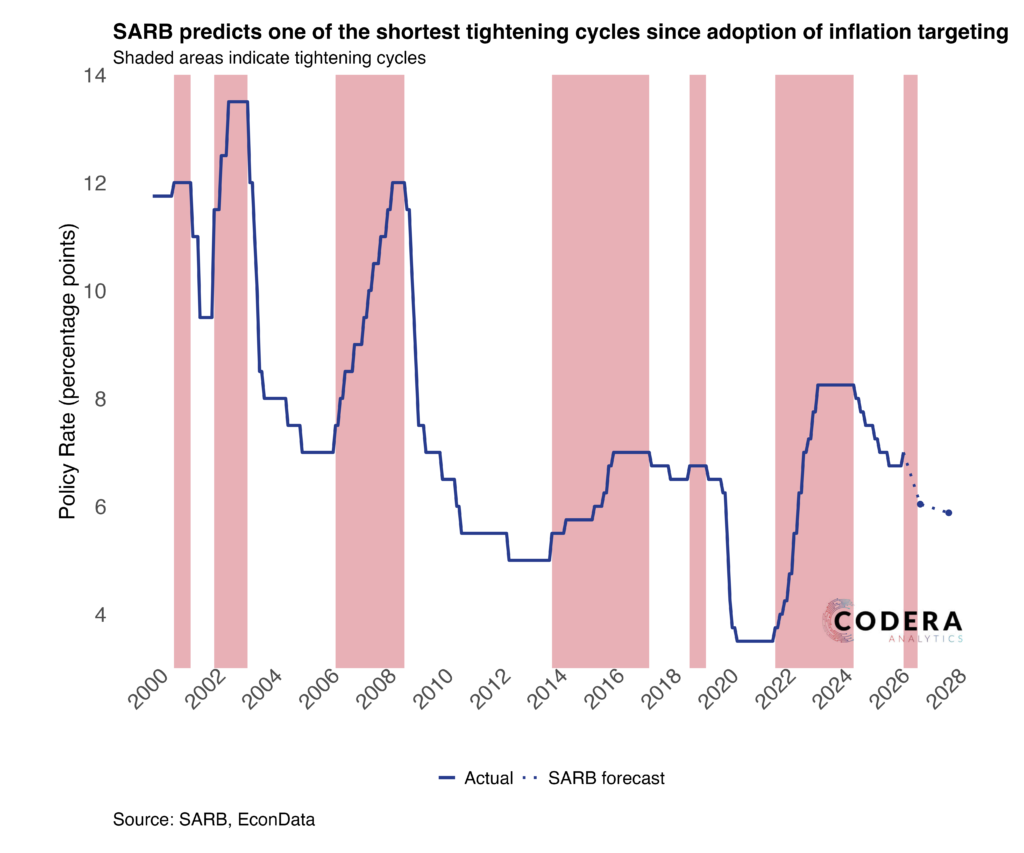
SARB’s latest projections implies one of shortest tightening cycles since the adoption of inflation targeting. After hiking in May, SARB’s baseline projection builds in a cut by its November meeting, and further easing in 2027. There is uncertainty over how long the disruption to maritime traffic through the Strait of Hormuz will continue, but the longer it does, the lower the chance of policy easing in 2026.
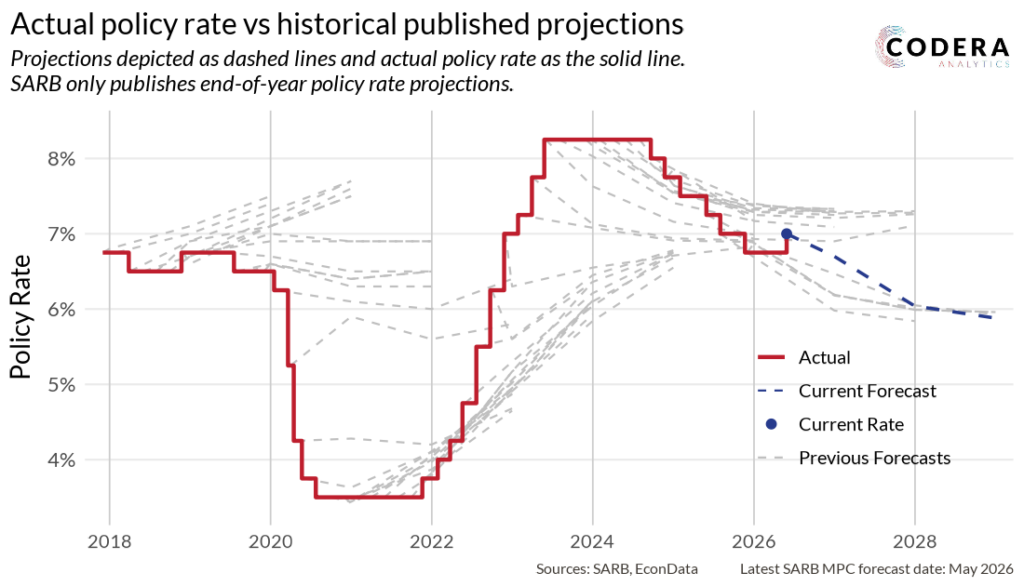
SARB has a tightrope to walk, as a spike in inflation is unfolding from oil supply disruptions. This shock has some similarities to the cost-of-living crisis of 2022 that was partly driven by an oil price spike following the onset of the Russia-Ukraine war. On that occasion, SARB assumed that the post-pandemic inflation impulse was a temporary demand-driven phenomenon. It projected a rapid decline in inflation, assuming it would be possible to cut the policy rate by late 2022, even as the Monetary Policy Committee was raising rates at every meeting in 2022. The SARB has since revised its interpretation of the drivers of post-pandemic inflation. Its modelling now assumes that the pandemic was predominantly a supply-related shock, a reversal of its earlier assumption that the pandemic inflation shock would be transitory.
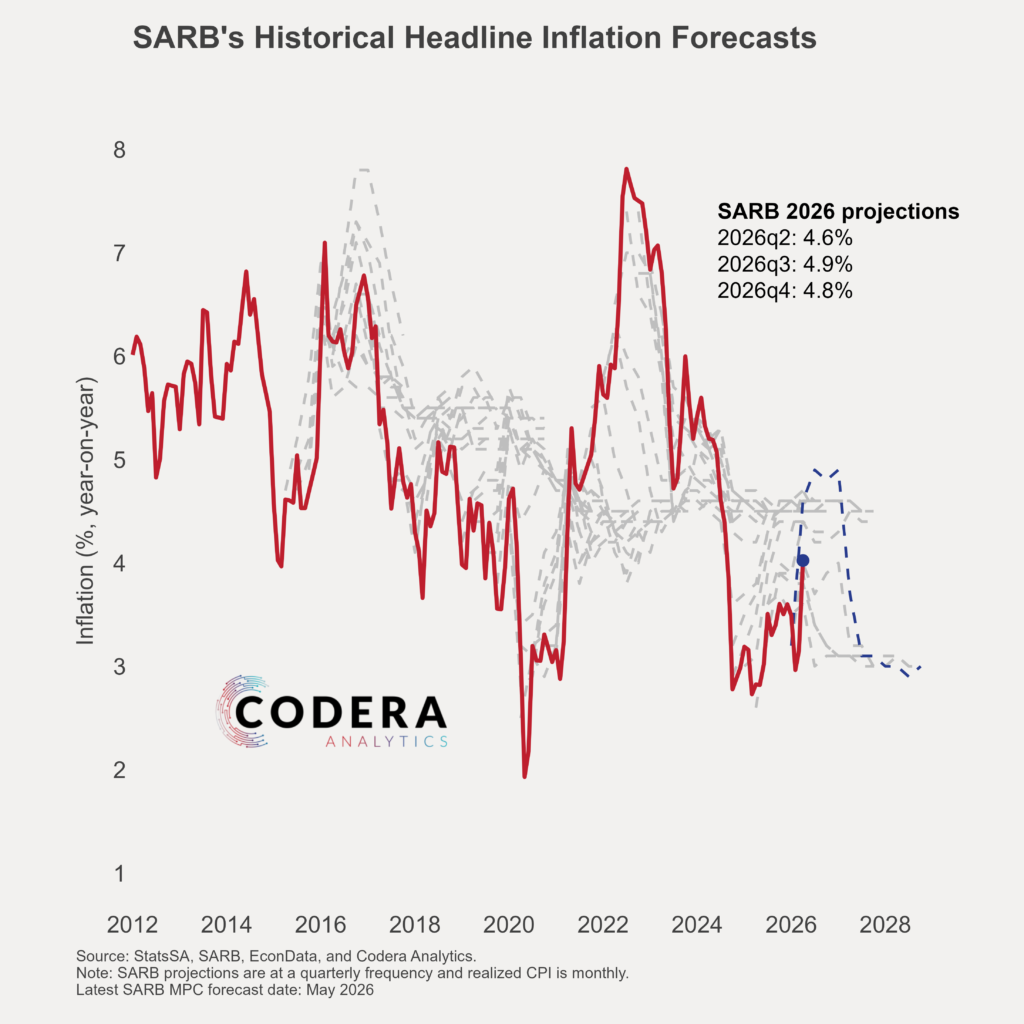
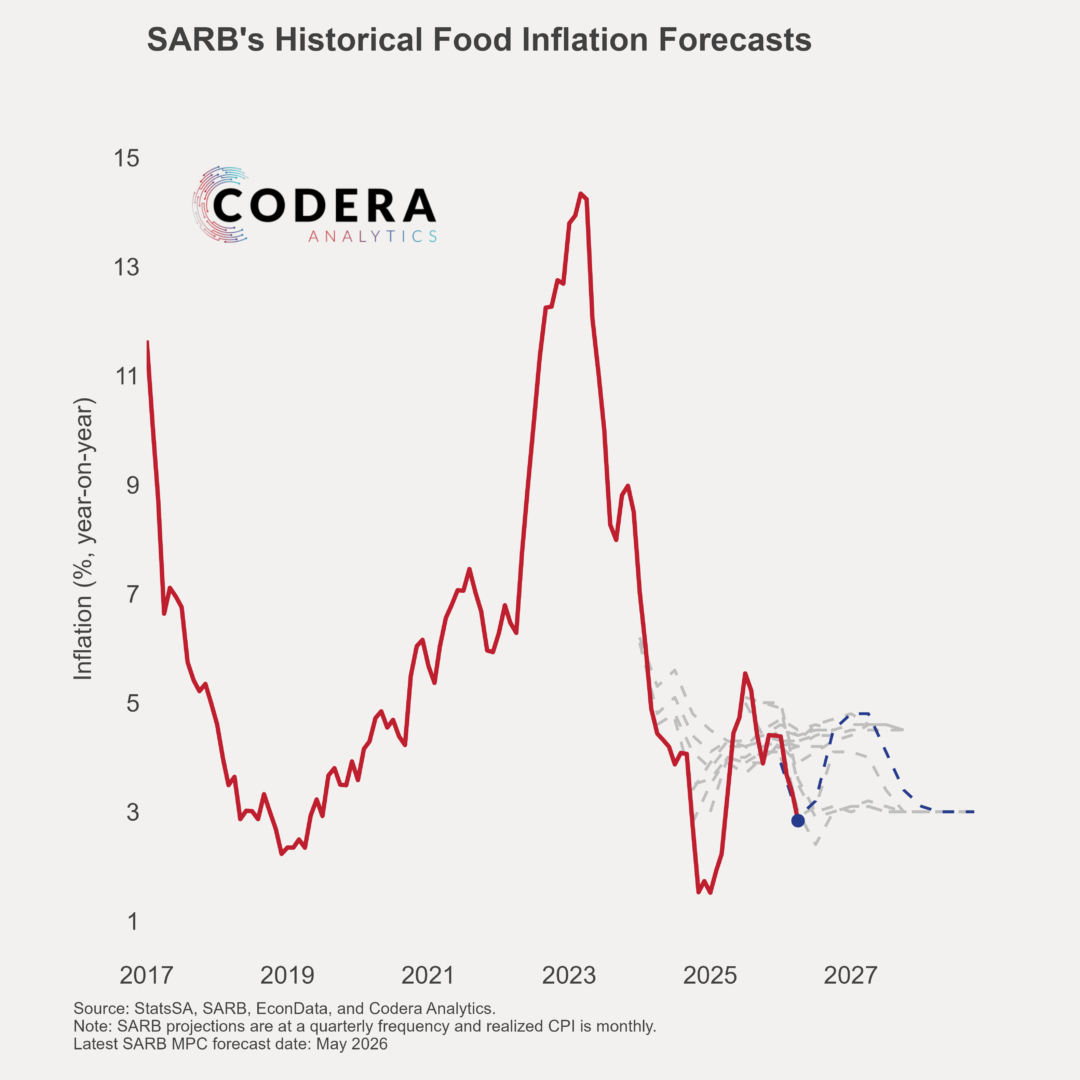
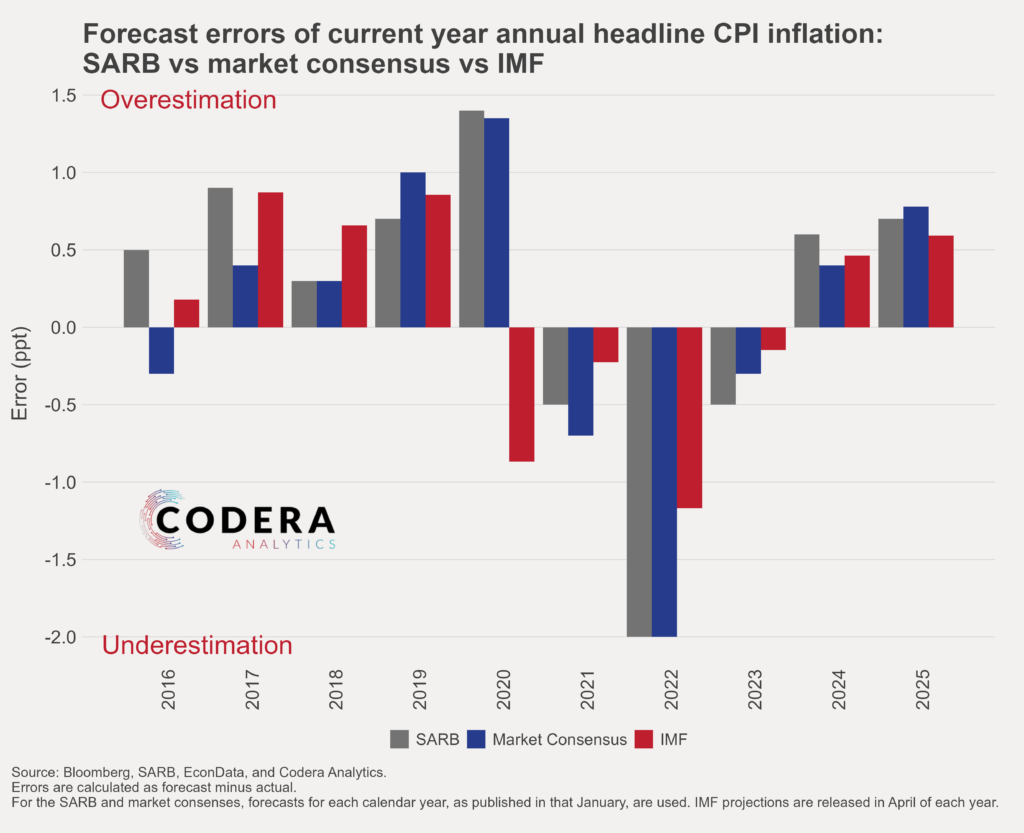
The private sector also missed the 2022 spike in inflation and took a long time to incorporate higher-than-expected inflation outcomes into their projections. Outside of the 2022-episode, SARB’s inflation forecasts have been quite accurate, with SARB’s annual forecast performance being comparable to the median private sector analyst.
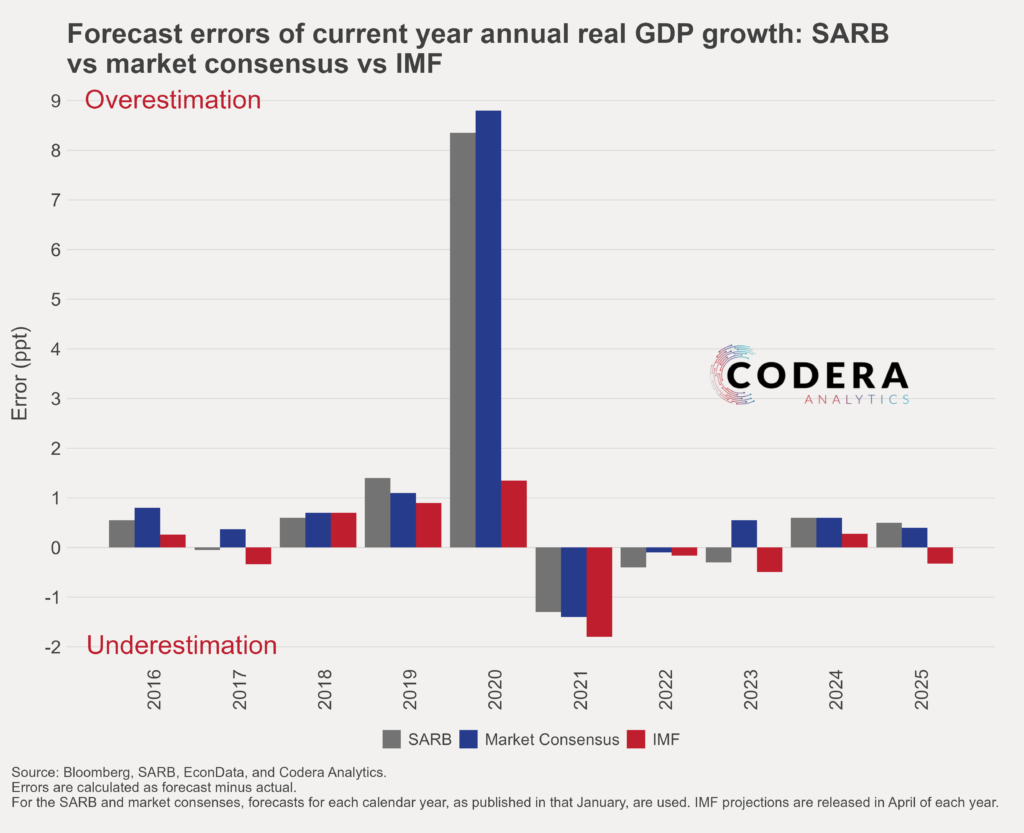
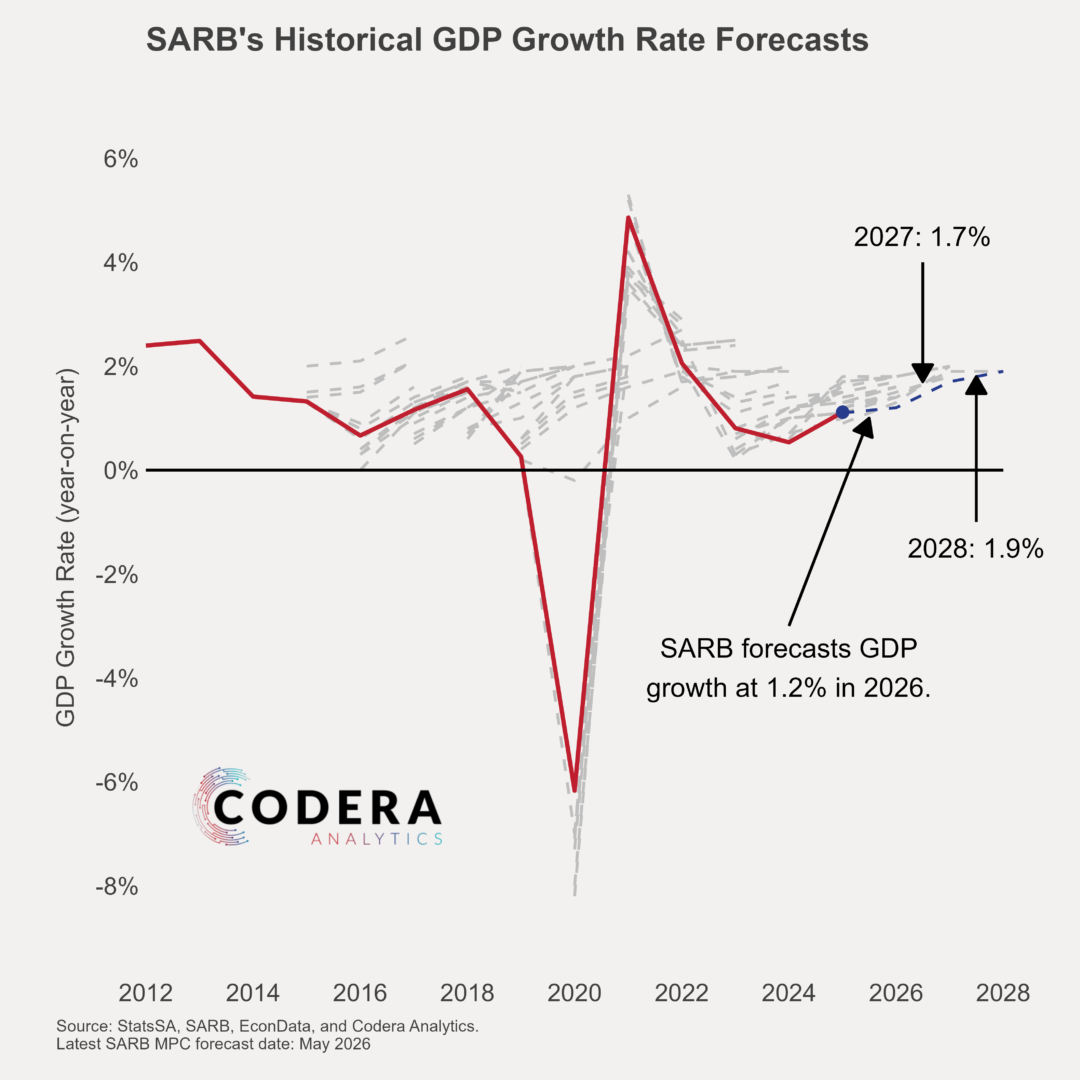
Although inflation forecasts are important for monetary policy decisions, what is more important is SARB’s assessment of the state of the economy and its commitment to doing what it takes to achieve the inflation target over the medium term. SARB has been continuously optimistic about South Africa’s growth outlook, as have private sector forecasters. The IMF, on the other hand, has been less optimistic, and the absolute size of their forecast errors since 2016 have been slightly lower on average.
The problem with SARB’s modelling is not inaccuracy. It is that it has continuously assumed that low growth outcomes have reflected excess capacity and that structural inflation is lower than historical trend inflation.
Chronic under-utilisation of resources either means that SARB over-estimated the economy’s growth potential or that the economy has persistently had spare capacity. The latter is unlikely: weak output growth tends to lower potential growth over time. Poorly calibrated monetary policy not only leads to forecast errors but potentially also inappropriate monetary policy settings. Since 2016, SARB’s January projections of the final quarter policy rate have been out by around 70 basis points on average if one excludes the 2020 pandemic year.
Inflation is set to rise further above the new target. We project that inflation will breach 5% by early 2027. But the outlook is uncertain: there could be upside risk to this projection should the oil shock lead to rising inflation expectations. On the other hand, inflation could moderate should global oil prices fall substantially, and the rand strengthens.
SARB’s projections assume that food inflation will settle at the inflation target, less than half the historical level of food price inflation (which has averaged 6.3% since 2009). SARB also presumes that government-related inflation will converge on the target. Even if just government inflation remains above the target, it will require keeping private sector inflation at around 2.5% on average over the long term, which means keeping interest rates higher. South Africa remains highly vulnerable to fluctuations in food prices, oil costs, and exchange rates, making it difficult to keep private sector inflation below this threshold each year.
Despite the risk that inflation might remain well above target for the next several months, SARB and many market economists still think rates could fall by year end. Market pricing, on the other hand, implies that the policy rate will continue to rise in 2026. What explains this divergence of views? Our estimates suggest that the market expects inflation to remain higher over the long term, with inflation expectations not as anchored as the surveys that SARB focuses on imply. Our analysis suggests that government borrowing costs have come down on account of lower sovereign credit risk, and lower inflation risk, not lower inflation expectations. This means that sustainably reducing inflation to the new target will require monetary policy to remain tighter for longer to re-anchor inflation expectations to a permanently lower level. This would also imply that the benefits of a lower target will be smaller over the next few years than SARB assumes, since borrowing costs continue to build in high inflation expectations.
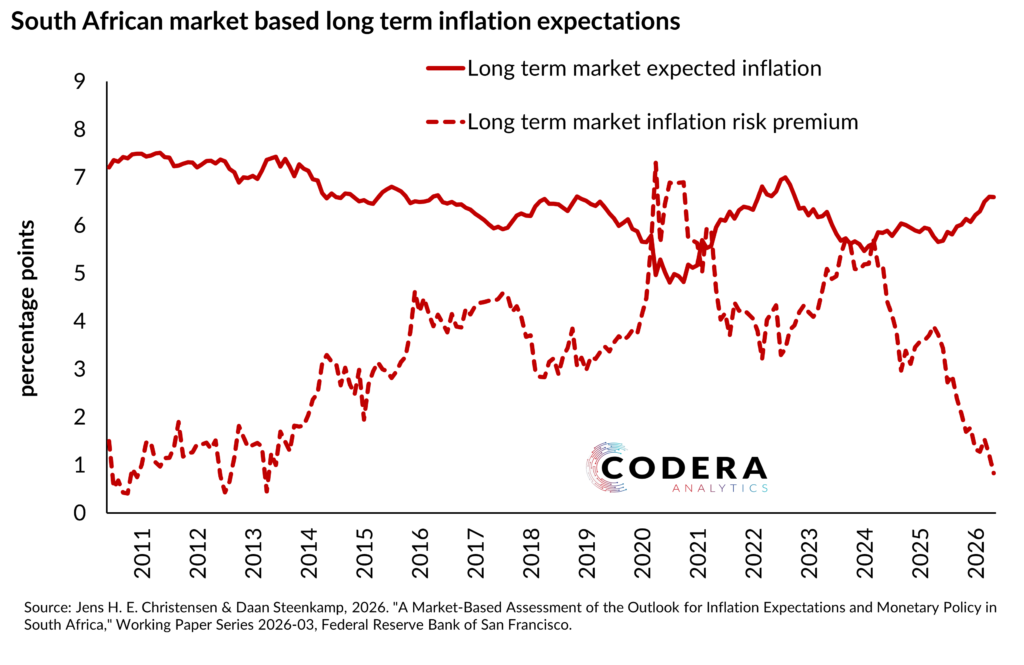
SARB was slow to react to the emergence of the post-pandemic inflation spike. The market expects the same this time round. The real question is whether SARB will get lucky this time, or if it will face another 2022-style reality check and be forced to revise its forecast assumptions.
Dr Steenkamp is CEO of Codera Analytics and a research fellow with the Economics Department at Stellenbosch University. Oliver Guest is a researcher at Codera.