Best practice among central banks is to either publish forecasts that align with the Monetary Policy Committee (MPC)’s current policy trajectory, or frame them as independent “staff projections.” The SARB, however, is a notable outlier, releasing projections that may deviate from actual MPC decisions. Because these forecasts are conditioned on a policy path different from the one being implemented, they naturally increase the risk of cross-variable forecast inaccuracy. More critically, this mismatch undermines the credibility of central bank projections as a forward-looking guide for monetary policy, risking asset mispricing and unnecessary market volatility.
Today’s chart highlights that this divergence between actual policy rate actions and the SARB’s forecasts widened dramatically over late 2022 and 2023. If we discount the unpredictable pandemic period itself, the subsequent recovery phase reveals a clear analytical blind spot. The SARB continued to interpret building inflation pressures as demand-driven, failing to anticipate the severity and stickiness of the post-pandemic supply shocks. Since the pandemic, SARB has revised its interpretation of the economic impact of the COVID pandemic, communicating in the October 2024 Monetary Policy Review that it now assumes that the pandemic was predominantly (75%) a supply-related shock.
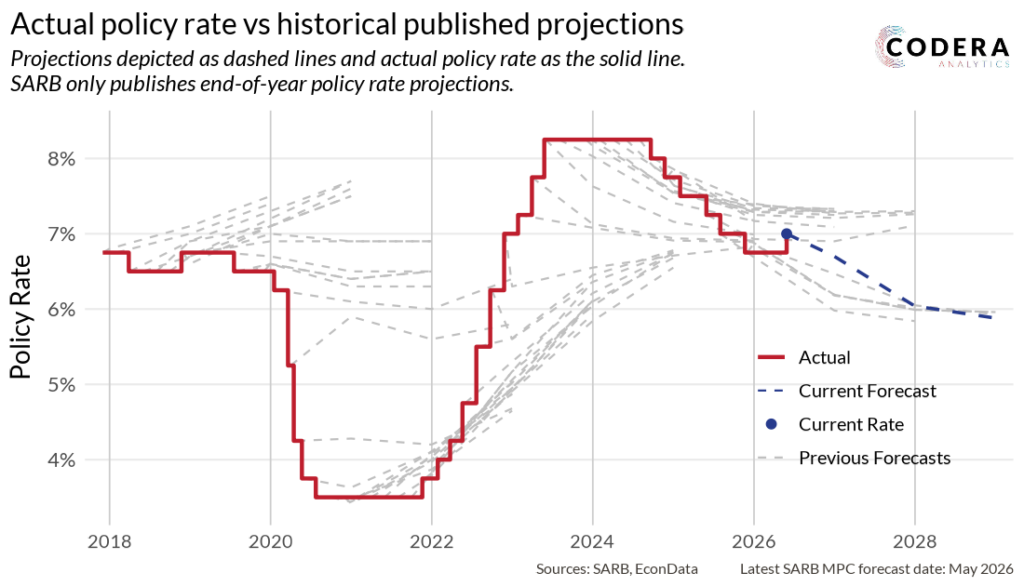
The most recent SARB projections assume that 25 basis points of cuts by the end of 2026 would be consistent with keeping inflation at the midpoint of the inflation target over the medium term. This would make this the shortest tightening cycle since the adoption of inflation targeting.
Footnote
Our EconData platform makes it possible for our clients to build dashboards that compare their projections from SARB, National Treasury and IMF. Contact us if you are interested in subscribing to our subscriber-only EconData Modules.