Today’s blog post is an unedited version of our Business Day article that summarises developments in night light intensity in South Africa.

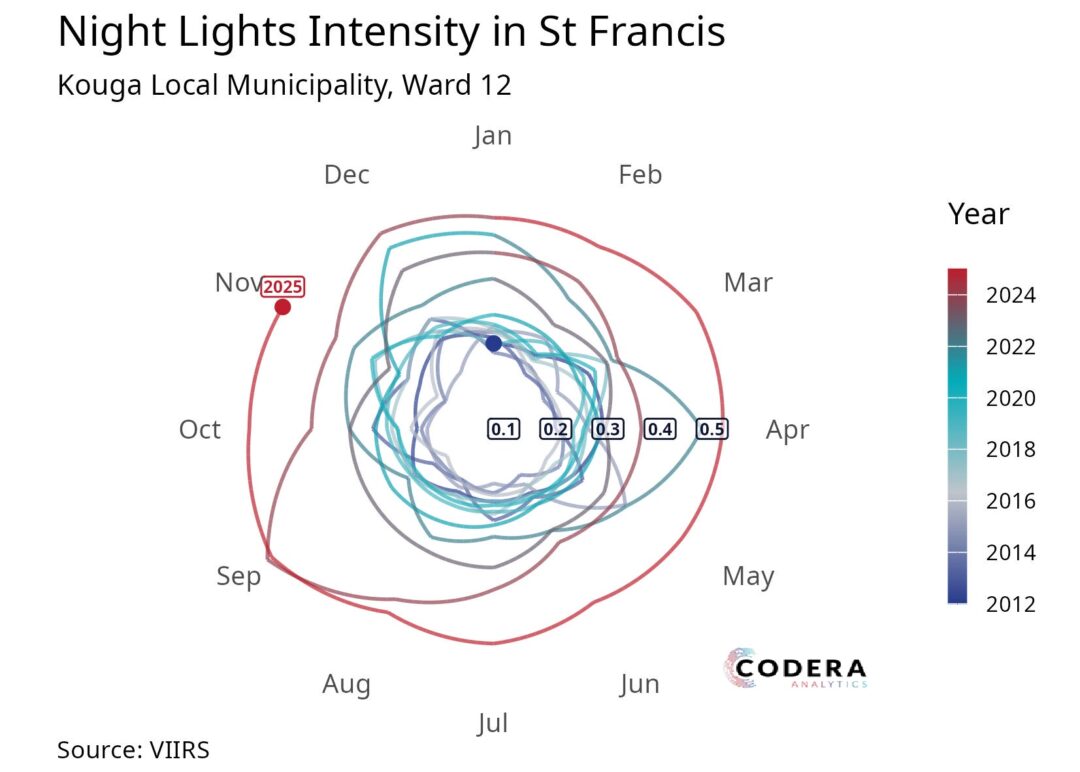
Over the December holidays, local and foreign tourists to the Western Cape coastline could be forgiven for thinking that South Africa’s economy is unmistakenly on the up-and-up. In the New Year as everyone returns to work (on average more rotund) the grim economic realities in the interior start to emerge. How well did South Africa’s economy actually do, on New Year’s Eve?
Unfortunately, economic activity estimates such a GDP arrive several months after the fact, which is at odds with the ever greater push to in-time information and services. How good could a forecast of the next six months be, if the actual input arrives when the period is half-way done? This has seen the development of a range of approaches to `nowcasting’: forecasting the present. Whilst the majority of these in the public mind is linked to high frequency financial data (think forex rates or stock prices), there are other sources in the real economy even more compelling.
In South Africa, as in much of the world, light emission is an excellent way to illuminate economic activity.
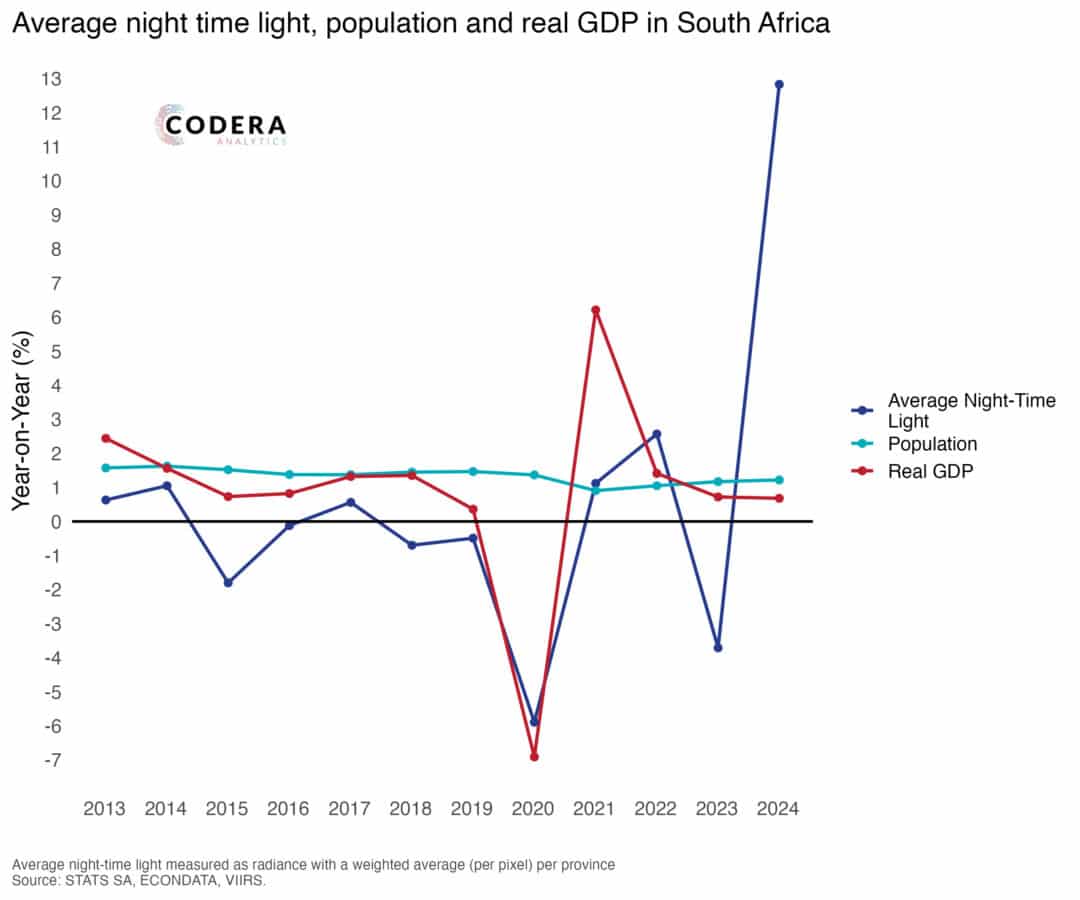
Our research shows that economic activity in South Africa is highly concentrated in affluent urban areas, while large populations in informal or rural settlements generate limited night light emissions. Although the suspension of load shedding in 2025 saw a recovery in night light in many areas, night lights have increased by less than 5 percent over the last decade. In fast-growing economies, such as China, night lights increased by over 6 percent per year over much of this period.
Despite the improvement in how efficiently energy is used in South Africa, our research raises questions about the depth of the structural slowdown and the ability of traditional indicators to fully capture shifts in spatial economic activity.
Unfortunately, provincial GDP data are published with a nine-month lag and is only available at an annual frequency. No regular sub-provincial indicators of GDP are available from official sources. Alternative data sources are therefore crucial to understanding real-time economic developments.
Although South Africa compares favourably to wealthy countries and other emerging markets in terms of the volume of economic and social indicators available, World Bank data shows that South Africa’s indicators are available on a less timely basis than for many major economies. This makes it difficult for firms to identify economic opportunities and threats. The reality of light emission is unmistakable, available on a timely basis and highly granular. Our estimates show the economic activity of specific suburbs as it happens.
Another notable implication of our South African estimates is that there has been little growth in the intensity of night lights in South Africa over more than a decade. Over the same period, fast growing emerging markets have experienced dramatic increases in night light intensity on account of rising incomes and infrastructure development. Despite population growth, ongoing urbanisation, and growth of informal settlements in South Africa, night light intensity has shown a much lower increase than observed in other economies.
In fact, the low increase in night light intensity in South Africa reflects declines in intensity in many urban and industrial areas. Most major special economic zones, which are designated areas offering tax and industrial incentives to promote industrialisation, have seen a large decline in night light intensity. Even at the high end, Sandton central or Saxonwold in Johannesburg, and Menlyn in Pretoria all saw declines in mean night lights between 2012 and late 2024.
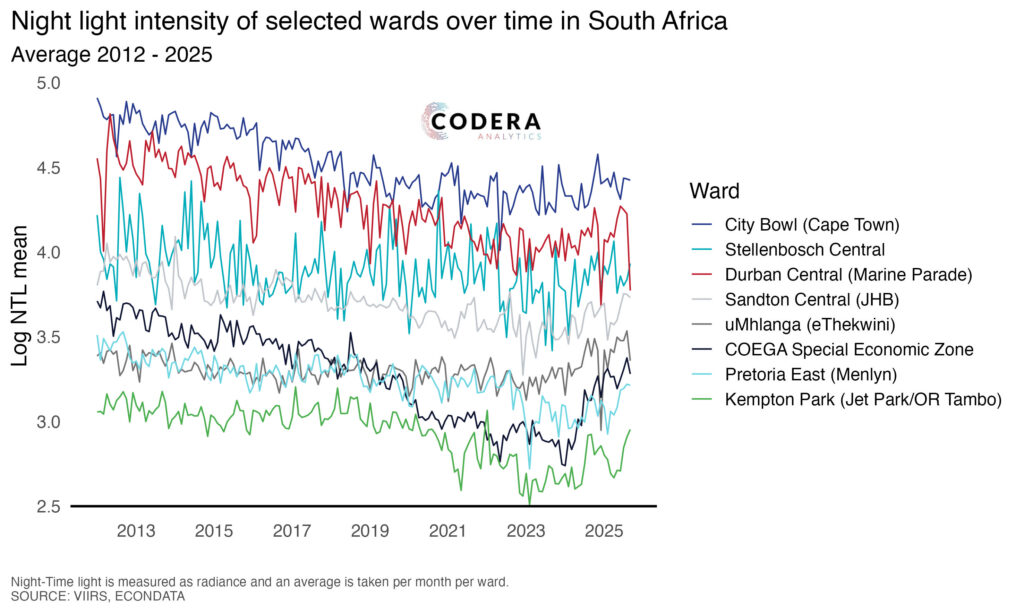
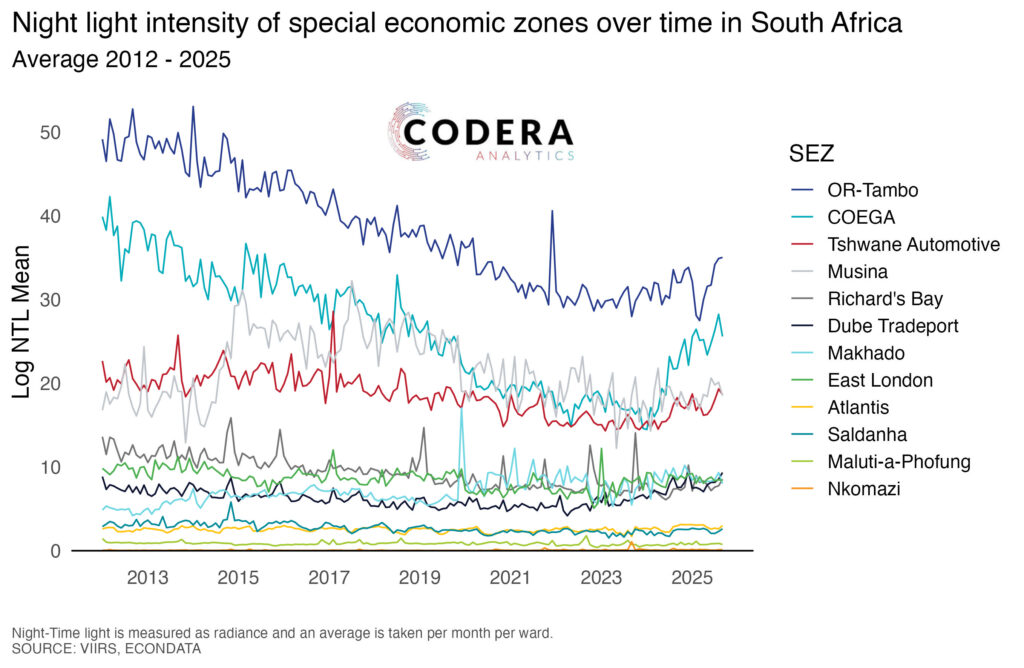
This most likely reflects the impact of municipal infrastructural degradation, including the breakdown of a large proportion of streetlights, as well as a shift to solar and off‐grid electricity supply. Another important reason is the decline in industrial and manufacturing production in South Africa. It is also possible that there has been some shift to more efficient lighting technologies, although this does not explain why night light has increased so much faster in growing developing countries.
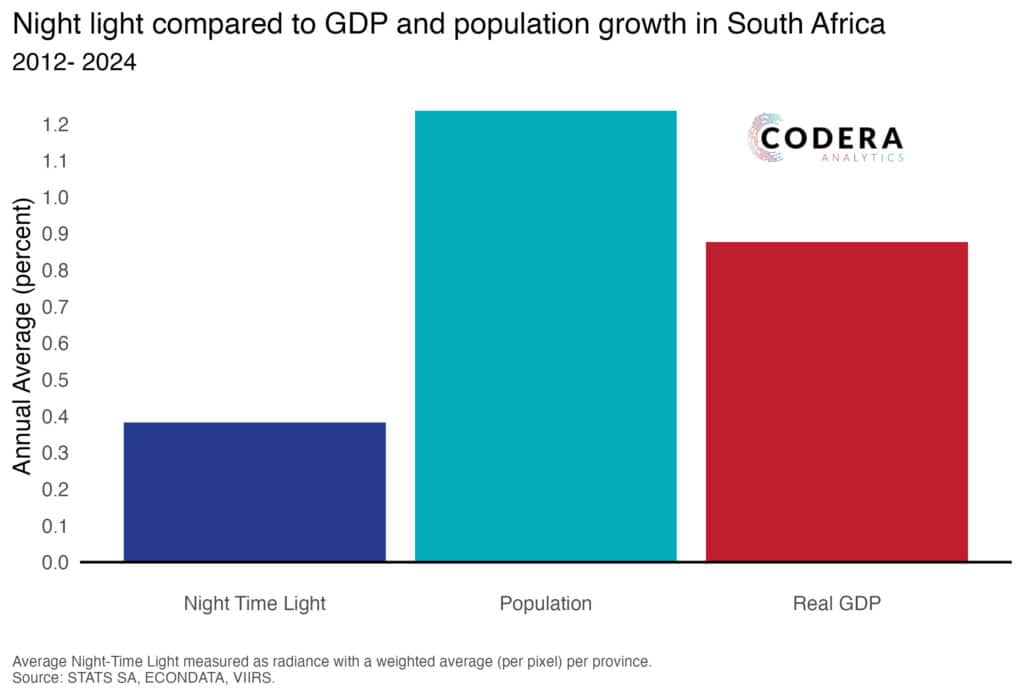
South Africa stands out for the decoupling of night lights from economic and population growth. Between 2012 and 2024, night light intensity rose at an annual average rate of only 0.4 percent. Real GDP rose at an average of just over double that rate, while population growth grew at more than three times this rate. However, light intensity does show migration patterns clearly: middle- and upper-class migration from Gauteng to coastal regions and the Western Cape is visible from space.
The Harvard Growth Lab report from 2023 showed how South Africa’s urban sprawl has been incentivised by government urban planning regulations and zoning policies. The report documents how this raises transportation costs and survival wages, discriminating against job creation and efficient service provision.
Satellite data therefore sheds light on the implications of the collapse of state service delivery and South Africa’s decline in GDP per capita over the last decade. A streetlight is the quintessential non-rivalrous non-excludable public good: everyone benefits from it and you cannot use it up. Satellite imagery is striking in its granularity and immediacy, providing a view of how good (or bad) municipalities are doing and where the money is really going. Unfortunately, the data highlight the widespread collapse in public service delivery, the decline in industrial and manufacturing production, and persistent low levels of urban densification compared to other fast growing emerging markets.
Once you take off the rose-tinted glasses of December, the economic reality in the interior is much darker than the fairy lights along the coast would make you believe.
Dr Steenkamp is CEO of Codera Analytics and a research fellow with the economics department at Stellenbosch University and Pietman Roos is an associate with Codera.
Codera’s report ‘Illuminating Economic Activity: Evidence from Night Lights Data in South Africa’ is available here